
Left of exploit
The term behind the Left of Exploit™ Brief.
This week's patch call, and what would prove it wrong.
Definition
Left of exploit is the period after a vulnerability is disclosed, while no public record confirms it is being exploited, when defenders must decide how fast to patch on judgment instead of evidence.
Where the phrase comes from
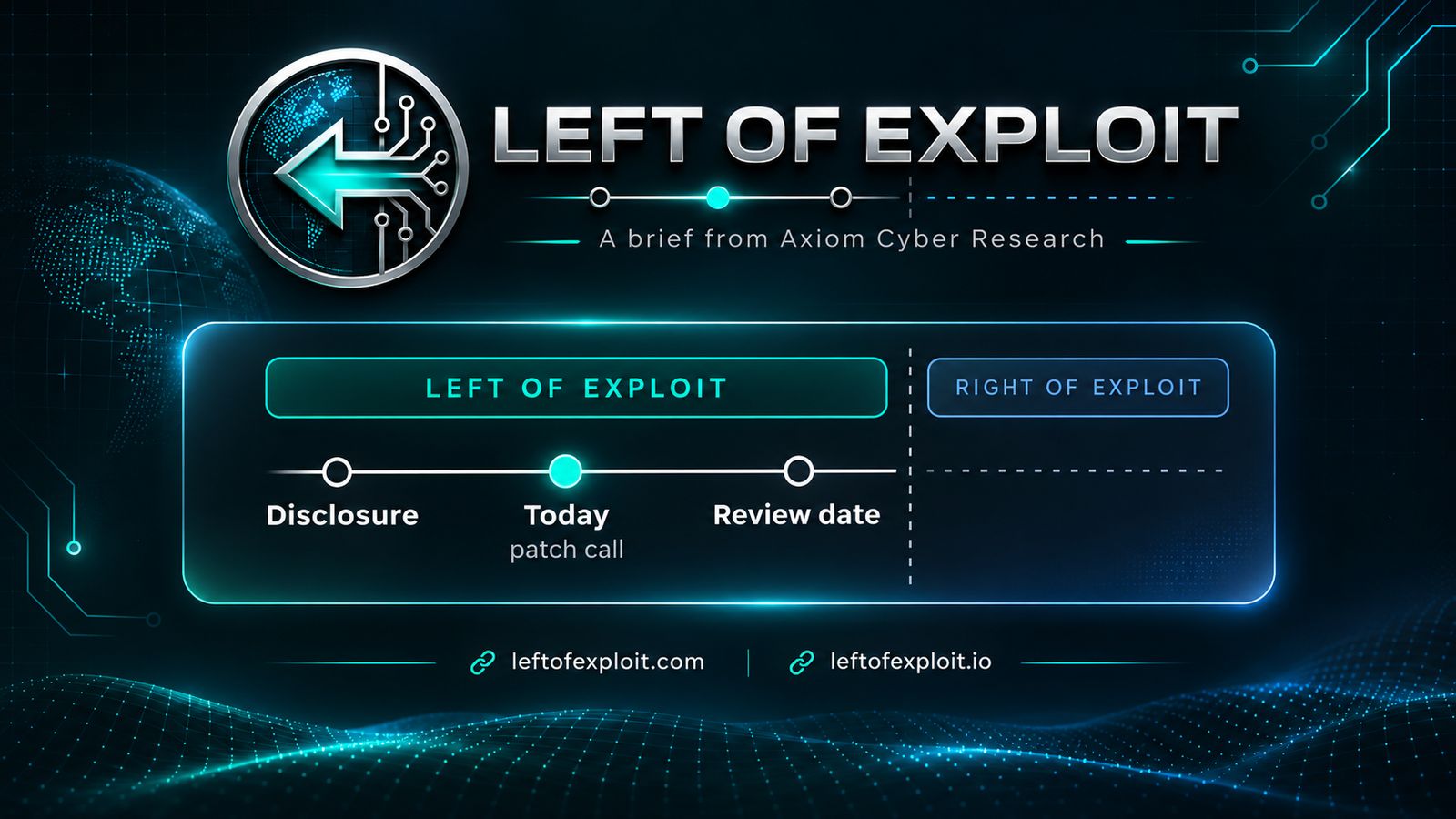
The phrase is borrowed. "Left of boom" is an established idiom for the time before an incident, from the habit of drawing events on a timeline that runs left to right. We apply the same picture to one point on a vulnerability's timeline: the point at which exploitation is publicly confirmed.
Right of exploit
Right of exploit is the state once a named public record confirms exploitation. Examples of such a record:
- the vendor's security team confirming exploitation;
- a listing in CISA's Known Exploited Vulnerabilities (KEV) catalog;
- a report from a national CERT or a named research firm.
From that point, the patching decision can rest on evidence.
A public proof-of-concept is not the line
A public proof-of-concept can exist while a vulnerability is still left of exploit. The line is confirmed exploitation, not exploit availability.
How we use it
Each call in the Brief names the vulnerability by its CVE identifier and carries a status line:
Status: left of exploit (as of <date>)
When a named public record confirms exploitation, we change that line publicly to "right of exploit". The status describes the public record as of the stated date. It says nothing about what will happen next.
Checking a call against public reports
A call on the call log can carry a timeline of the public reports about it, each with its date and a link to the source. You can open every report and check its date against the date of our call.
On a timeline
The Brief
The Left of Exploit Brief is published by Axiom Cyber Research. Every call it has made, with its current status, is in the public call log. To receive the Brief, see the subscribe page.
Axiom Cyber Research: Left of Exploit Brief is research opinion as of its stated date, not a guarantee or professional security advice.
Axiom Cyber Research is not affiliated with or endorsed by CISA, MITRE or any vendor named.